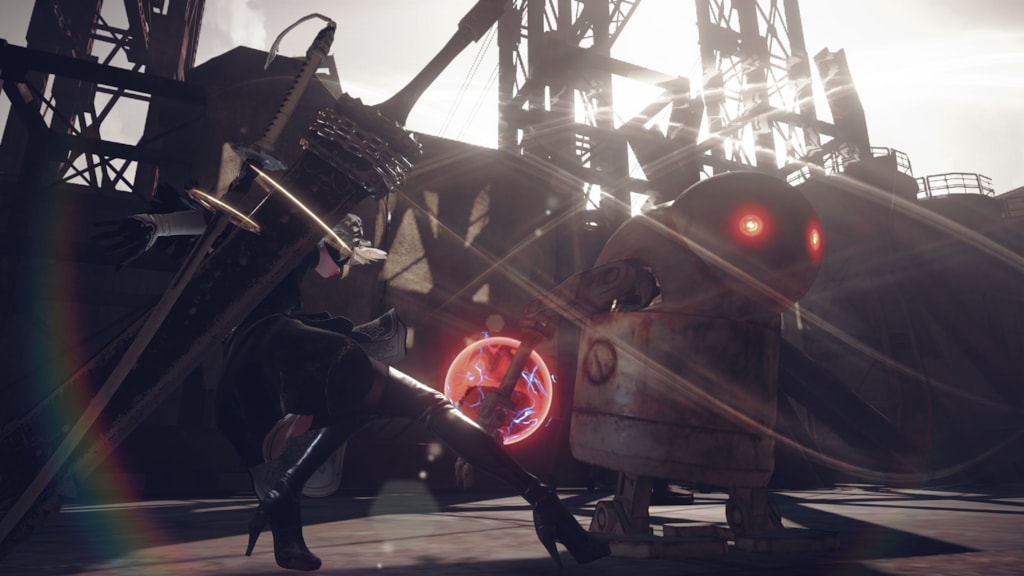
NieR: Automata, released in 2017 with a later ‘complete’ release in 2019, is a character action game developed by PlatinumGames and published by Square Enix. It follows androids 2B and 9S as they fight in a war against the alien-created machines in the far future. What I found most interesting in the game is how it tackles the idea of how much control we have over the self. The core of this centres around how our actions and thoughts define the self, what control we have over this, and what you do when so much of who you are is defined by a control you do not have.
Thoughts as the Self
NieR: Automata starts by teaching us the core of the world. Earth is being invaded by machines created by aliens. This war has been going for so long and become so fierce that humans escaped to the moon whilst YoRHa, an institution formed to fight back the machine invasion, reclaims Earth. Playing as 2B and 9S, two androids working for YoRHa, we work towards ending this war. However, as we go through the game our understanding of machines start to fall apart.
Machines are portrayed as mindless husks controlled by simple logic in their programming; killing them is no different to breaking a computer. Their open hostility leaves no room for negotiation; fighting is the only way forwards. This changes when 2B and 9S are tasked to clear out machines in the desert. These machines are just as hostile as the others we have seen. Where it differs is that these machines have protective instincts of this land and a fear of being killed. That these machines have formed some sort of emotion is completely counter to what we have been taught thus far. 2B, like the player, hesitates and worries about what she is doing. 9S tries to reassure us by reconfirming the idea that machines are faking this within their logic, but why are they only saying all this in the desert?
The next task 2B and 9S are tasked with is to see what happened to an expedition of androids that went into the amusement park. This place is full of machines, more than any place we have seen yet, and fighting through them is a chore. But something feels off about this place. It turns out that none of the machines are hostile unless you attack them first, only fighting in self defense. Instead, the machines are celebrating and trying to spread ideas of love and peace. And right after this we are introduced to Pascal’s village; a community of machines that broke free of the machine network and are trying to live as pacifists. It is full of machines with a breadth of personalities that have formed families and friendships.
All of this contradicts what 2B, 9S, and the player have been taught. Machines aren’t mindless husks, they are sentient beings with thoughts and feelings just like androids. What we were taught is different to what we have experienced; a contradiction external to YoRHa.
The world contradicting your understanding is one thing, but what if it’s the institution that contradicts itself? At multiple times through the game, 2B and 9S are tasked with tracking down and eliminating rouge YoRHa androids that have deserted. Androids and machines are enemies, so why would an android desert from the institution fighting them? The commander of YoRHa tells us that these deserters have stolen from the android resistance on the surface, but looking into this reveals no evidence. Killing your fellow android is already so difficult that when the conditions become so murky, your understanding of YoRHa shatters. What we were taught is different to what we are told to do; a contradiction internal it YoRHa.
Our thoughts being challenged by what we experience is normal and happens to us all. Through our childhood we are limited to being taught things by specific people and specific institutions. We have little-to-no control over our upbringing. 2B and 9S are the same. They were created by YoRHa and programmed with a faux-childhood teaching them the ideals of YoRHa. With our thoughts being so tied to our sense of self, who we are is unclear. How do you take control over a mess of contradictions?
Actions as the Self
Thoughts are one thing, but what about a more direct showing of who we are; our actions. As we discussed above, machines are sentient so there is more nuance in killing them. So in spite of this knowledge, why are we killing them so indiscriminately? To start, 2B and 9S are android soldiers, literally created to fight. The only way they know how to interact with the world is through fighting. And that’s the same for us. We are taught to interact with the world through the mechanics of fighting. But even if all we know to do is fight, why can’t we try something new?
The joy implicit to the act of violence in NieR: Automata is a major part of this. We are playing the game because we enjoy character actions games. The depth in the fighting and clearing through enemies is enjoyable. This is the same for 2B and 9S. In a quest helping resistance member Jackass with research, she informs us that “androids actually generate a pleasure-granting chemical while in combat”. Like the player, 2B and 9S both take great pleasure in the only way they can interact with the world.
This can come across as frustrating for the player. Why is the game criticising me for playing it like it wants me to? But it is this frustration that makes it work. For one, this is the challenge felt by 2B and 9S in their struggle then reinforced by the mechanics. Do you take the easy and enjoyable way out by fighting whatever machine is in front of you? Or do you put in the work to be better, wresting control from your base urges and understanding? A more explicit example of this happens when you come across a tank in the amusement park. We know these machines are celebrating peace and love, but a tank is both threatening and would be fun to fight. 9S even encourages you to do so stating that leaving it alone will just endanger us later, a massive Chekhov’s gun. This threat and understanding that we can only fight might lead you to attack it when leaving it alone means you never see it again. You miss out on enjoying the fight, instead letting the machines live; immediate frustration balanced out by choosing to do good.
Even so, fighting is pushed onto us in another way beyond simple pleasure. Scattered across the map are quest markers which act as orders or requests for 2B and 9S to complete. And almost all of these quests require you to kill machines in some way. 2B and 9S do this because they are a part of YoRHa and refusing orders or not being useful is dangerous in this organisation. We already know that deserters are charged with execution, but a similar fate lies elsewhere. Androids have the ability to back up their memories and be brought back after death in a new body. However, is reliant on YoRHa’s servers and backup bodies. Going against this system risks 2B and 9S’s lives beyond simple execution.
The player controlled as well, but through the systems of games as a whole instead. We are conditioned to seek out and complete all these quests that appear based on previous experience in other games as well as how intrusive the quest markers are on the map. Completing quests is part of the core gameplay and each one has rewards and interesting story. Of course the player is going to do them. This control is more subtle on the player, forcing them to keep fighting machines in search of why they are fighting them.
But is doing these quests a bad thing? Yes, we are killing machines, but we do have a reason. Many quests are about saving others in some way. There is a lost child from Pascal’s village that we protect from other machines in the desert, we collect parts from hostile machines in order to fix androids in need of parts, and sometimes there is an out of control machine that could hurt others if it isn’t stopped. These quests require you to fight, but for the protection of others. Can you justify this violence? And if you can, does it mean you have taken control by choosing to do it?
How to Reclaim Control Over the Self
Gaining control over our thoughts is difficult. How we are raised determines how we think for our early lives. From this we experience contradictions both internal and external to the systems we are in. But it is these contradictions between the world as we are taught it and the truth we discover along the way where the self truly blooms. 9S comes to appreciate Pascal and his village in spite of the inherent hatred of machines he was taught, 2B learns how to use her actions for herself instead of for YoRHa. Falling back onto the contradictions of the system and staying as you are is easy, but the harder path of confronting them head on gives you control over who you are.
Having control over your actions is more complicated. You may have the threat of an institution over you, but even as a soldier you have more control than it initially appears. Many machines can be ignored instead of killed, side-quests can be skipped if you don’t agree with them, and the choice of using violence for yourself returns your control. But even with these moments of freedom, you are not fully free. Unlike side-quests, the main-quest can’t be ignored. It requires the destruction of machines and the death of androids which is forced on 2B and 9S through YoRHa’s control over their lives. There is a dissonance deep within us when forced to act counter to our beliefs in order to survive.
However, the one thing we need to remember is that we are forced into these acts. Do not despair over having done such things when our lives, and those of the ones we want to protect, are at stake. Instead, do the difficult task of remembering what we do have control over and using each small act of freedom to claim yourself. Eventually these acts will build up and you will be able to create a larger space to be free in.
2026-03-18 – jam-alade